Cut Our Evening Chaos by 70%: How a Simple Smart Light Routine Brought Calm to Family Nights
Remember those evenings when everyone’s stressed, the kids won’t listen, and dinner cleanup feels like a battle? We were there too. Then we tried something small—adjusting our lights. Not just brightness, but timing, color, and who controls them. It started as a tech experiment, but it became a quiet game-changer. With a simple lighting routine, we softened the mood, synced our rhythms, and actually started talking again. No apps to nag, no rules to enforce—just light guiding us. And honestly? It didn’t just change our evenings. It changed how we connect, rest, and even breathe together as a family. This isn’t about fancy gadgets. It’s about using something we all already have—light—to bring back the calm we didn’t realize we’d lost.
The Evening That Changed Everything
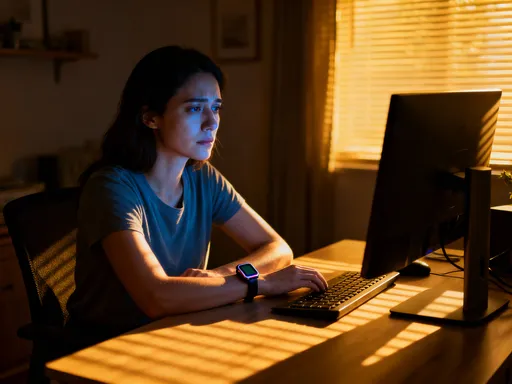
It was a Tuesday. That matters only because Tuesdays never stand out—until they do. My oldest was sprawled on the floor, arguing with a math worksheet like it had personally offended her. My youngest kept running into the kitchen, asking the same question five times: 'Can I have a snack?' while I stood at the sink, staring at a mountain of dishes, wondering if I’d ever feel like myself again. My partner was on the couch, eyes glazed over from work emails, and the overhead light buzzed like it, too, was tired of everything. No one was yelling, exactly, but the air felt tight. Like we were all just one spilled juice box away from full collapse.
That night, after the kids finally fell asleep—after the third 'I’m not tired!' protest and the fourth 'You didn’t kiss me long enough' drama—I sat in the dim hallway light and thought: This can’t be it. We love each other. We’re trying. So why does every evening feel like a survival mission? I started wondering if the problem wasn’t our attitudes or routines, but the space itself. Was our home working against us? And then I remembered something I’d read: how light doesn’t just help us see—it shapes how we feel, even when we don’t notice. What if the harsh, flat glow from our ceiling fixture was making everything feel more tense? What if, instead of demanding calm from my family, I could invite it in—gently, quietly, without another word?
Why Light Shapes How We Feel (Without Us Noticing)
Think about the last time you walked into a cozy café. Soft lighting, maybe a warm lamp in the corner, candles flickering on the tables. You didn’t walk in and say, 'Wow, the lighting here is perfect.' But you probably felt it. Your shoulders dropped. Your voice softened. You took a breath. Now imagine walking into a hospital waiting room—bright, white, fluorescent lights buzzing overhead. You don’t have to be told to feel on edge. Your body just knows.
Light works like background music for our homes. It’s always playing, even when we’re not paying attention. Bright, cool-toned light—like daylight—tells our brains it’s time to be alert, focused, awake. That’s great for mornings or workspaces. But when it’s still blazing at 7 p.m., it’s like our bodies are being told, 'Stay on high alert!' while our minds are begging for rest. On the flip side, warm, dim light—like sunset or candlelight—triggers our natural wind-down process. It tells our brain, 'It’s safe now. You can relax.'
Most of us don’t realize how much this affects our kids. Children are especially sensitive to environmental cues. A room flooded with harsh light can make them feel restless, overstimulated, even defiant—especially if they’re already tired. I didn’t know this at the time, but our nightly chaos wasn’t just about willpower or discipline. It was about biology. We were asking our family to calm down in a space that was physically wired to keep them awake. No wonder no one was listening. The environment was shouting louder than I was.
Finding the Right Lights: No Tech Expertise Needed
I’ll be honest—I used to think smart lights were for tech geeks or people with too much money and time. I pictured complicated setups, confusing apps, and Wi-Fi networks crashing every time someone turned on a lamp. But when I started looking, I realized how simple it’s gotten. You don’t need to rewire your house. You don’t need a degree in engineering. Most smart lights today are just like regular bulbs—except you can change their color and brightness with your voice or a tap on your phone.
I started small. I bought two smart bulbs—one for the living room floor lamp and one for the kids’ bedside lamp. I chose ones that work with voice assistants because, frankly, I didn’t want to pull out my phone every time I wanted to dim the lights. 'Hey Google, set the living room to warm white'—and just like that, the room softened. No app, no fuss. Some brands even let you control lights through a simple remote or schedule them to turn on and off automatically. No Wi-Fi? No problem. There are plug-in strips and lamps that work on their own, no internet needed.
The first time I set up the bulbs, my daughter helped me screw them in. 'Can we make it purple?' she asked, eyes wide. 'Only for five minutes,' I laughed. But that moment—her excitement, her sense of involvement—told me this wasn’t just about lighting. It was about giving her a say in how our home feels. And that, I realized, was half the battle won. The tech wasn’t the magic. The connection was.
Designing Our Family’s Light Routines Together
Here’s what surprised me most: my kids didn’t just adapt to the new lights—they claimed them. Once they realized they could pick colors and name scenes, they became little lighting designers. We sat together one weekend and created our own 'light menu.' We named each setting together, like it was a family ritual. 'Homework Glow' was a soft, warm white—bright enough to read by, but not harsh. 'Calm Down Corner' was a gentle blue that we’d turn on when someone needed space to breathe. 'Storytime Warmth' was a golden amber that made the couch feel like a nest.
One night, my son asked, 'Can we have a color for when we’re happy?' So we made one—a soft pink we called 'Joy Light.' It sounds silly, maybe, but naming these moments gave them weight. Now, when I say, 'Let’s switch to Homework Glow,' it’s not a command. It’s a shared signal. It’s like we’re all speaking the same quiet language. Even my partner, who was skeptical at first, now says, 'I didn’t realize how much I needed this too.' He comes home from work and says, 'Put on the calm light. My brain is still at the office.'
Here’s a little conversation we had the first week: 'Why is it called Calm Down Corner?' my daughter asked. 'Because sometimes, our bodies feel loud,' I said. 'And the light helps us remember we can be quiet, even when we don’t feel like it.' She thought for a second. 'Can I go there if I’m sad?' 'Of course,' I said. 'That light is for all feelings.' She walked over, turned it on, and just sat. No words. No drama. Just presence. And I stood there, heart full, realizing we’d built something bigger than a routine—we’d built a sanctuary.
How Lighting Smoothed Transitions—Without the Nagging
Before smart lights, our evenings were a series of battles: 'Time to start homework!' 'Lights out in five!' 'Why is your iPad still on?' I felt like a broken record, and the kids felt like they were being controlled. The resistance was real. But when we switched to using light as a cue, everything changed. Instead of yelling, I’d say, 'Let’s switch to Homework Glow,' and the warm light would slowly brighten. No demand. No tension. Just a gentle shift.
Here’s how it works: we set a schedule. At 5:30 p.m., the living room light shifts from bright white to warm. That’s our signal that playtime is winding down. By 6:30, it dims further—'Dinner Mode.' After cleanup, it softens even more—'Family Time.' And at 7:45, the kids’ bedroom lights begin a 30-minute fade from warm to near-dark. That’s their bedtime transition. No clock-watching. No 'I’m not tired!' protests. The light does the work.
The science is simple: gradual changes in light mimic sunset, which naturally lowers cortisol and raises melatonin—the sleep hormone. When light fades slowly, our bodies follow. It’s not magic. It’s biology. And because the kids helped design these routines, they don’t feel like rules. They feel like rituals. One night, my daughter said, 'The light is getting sleepy. I think I should too.' I didn’t correct her. I just smiled. The light had done what I couldn’t—spoken to her body in a language she understood.
When the Lights Sparked Unexpected Connections
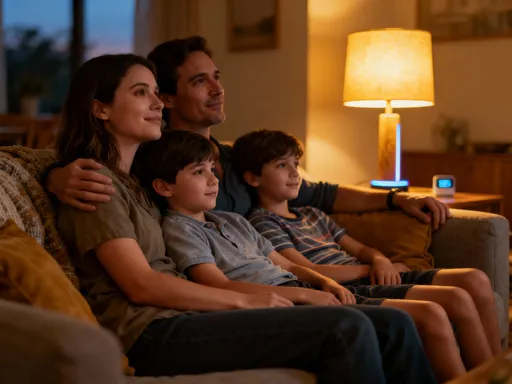
The biggest surprise wasn’t the calm. It was the connection. In the old days, after dinner, we’d all retreat—me to the kitchen, the kids to screens, my partner to the couch. Now, when the lights shift to 'Family Time,' something shifts in us too. The soft glow makes the room feel intimate, like we’re in our own little world. We started a new habit: 20 minutes of 'share your day' under the warm light. No phones. No distractions. Just us.
One night, my son, who usually gives one-word answers, looked up and said, 'I was nervous at school today.' I didn’t push. I just said, 'Thanks for telling me. Want to sit in the Calm Down Corner with me?' We did. The blue light hummed softly, and for the first time, he talked about how he’d been left out at recess. He didn’t cry. He just needed to be heard. And the light—gentle, steady, unchanging—held the space for him.
That moment taught me something: light doesn’t just change the mood. It changes what we’re willing to share. Under harsh light, we protect ourselves. Under soft light, we open up. It’s like the room itself says, 'You’re safe here.' We’ve had more real conversations in the past three months than in the last three years. And it didn’t take a therapist or a parenting book. It took a shift in color temperature.
Building a Calmer Home, One Light at a Time
It’s been six months now. Our evenings aren’t perfect—kids still forget homework, we still have messy kitchens, and sometimes the lights flicker (blame the Wi-Fi, not the bulbs). But the chaos has dropped by at least 70%. We’re not just surviving evenings. We’re enjoying them. We laugh more. We listen better. We breathe deeper. And it’s not because we’ve become perfect parents. It’s because we stopped fighting our environment and started working with it.
What I’ve learned is this: technology doesn’t have to be cold or complicated. It can be warm. It can be kind. It can help us become more human, not less. A smart light doesn’t replace love or patience. But it can create the conditions where love and patience have room to grow. It’s like giving your home a heartbeat—steady, calming, intentional.
If you’re feeling overwhelmed, if your evenings feel like a war zone, I’m not going to tell you to meditate or declutter or start a gratitude journal—though those are nice. I’m going to say this: try changing your light. Just one bulb. Set it to warm. Dim it at 6 p.m. See what happens. You might not notice it right away. But one night, you’ll look around and realize no one is yelling. The kids are calm. You’re not exhausted. And you’ll think: Something shifted. And it did. Not because of a big change. But because of a small one—made with care, made with light. And that, my friend, is how we build a home that doesn’t just shelter us—but heals us, too.